
Sleep and Rest by Design: Why Your Type Decides How You Rest
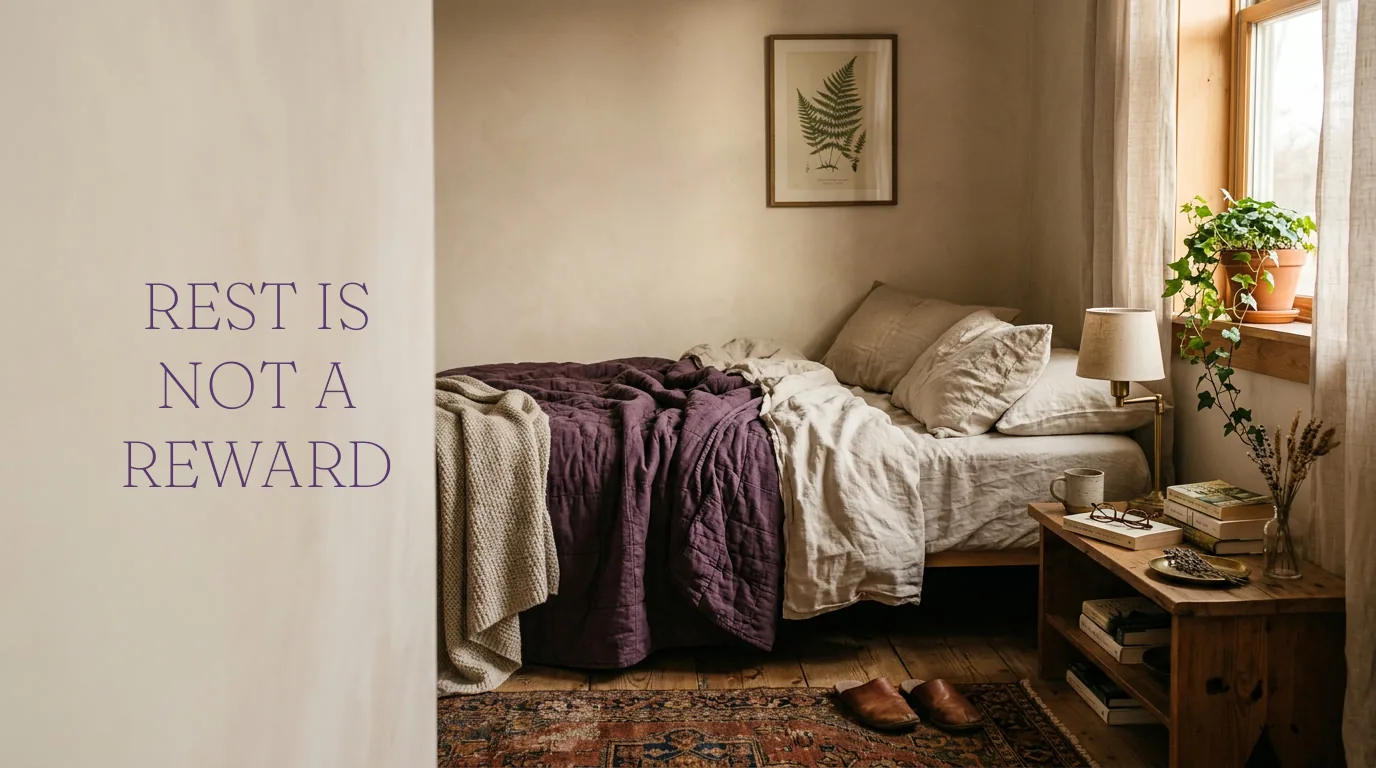
It is eleven at night and you are tired in a way that has nothing to do with the day you had. You did the work, you answered the messages, you were pleasant to everyone who needed something, and now you are lying awake with a body that will not switch off. Or maybe the opposite: you fell asleep the moment you sat down and woke at three with your heart going. Either way, the usual advice has not helped. Go to bed at the same time. Put the phone away. Wind down. You have tried all of it.
There is a reason it has not worked, and it is not that you are bad at sleeping.
Why rest is the first place your design shows up
Of all the places your Human Design plays out, sleep is the least glamorous and the most honest. You cannot perform your way through it. Nobody is watching, there is no reputation to protect, and the body simply does what it does. That is exactly why the friction shows up here before it shows up anywhere else.
Most sleep advice assumes one kind of body, running one kind of engine, that powers down on command. Some of that advice is genuinely good and worth keeping.
But it was not written for everyone. Your type tells you what kind of energy you are actually running, and just as usefully, what kind you are not.
There is a quieter reason too. Sleep is when you stop doing, and most of us have built a life where stopping feels faintly dangerous. If you have ever felt guilty for going to bed early, you already know exactly what I mean.
Generators: the motor needs to be spent
If you are a Generator you have a defined Sacral centre, which means a real and renewable motor sits at the centre of you. It is built to respond and it is built to be used. The catch is that unused energy does not quietly vanish overnight. It stays in the system, humming.
This is the classic Generator insomnia. You had a day full of obligations that were not really yours, you never got to say a wholehearted yes to anything, and by midnight the engine is still idling in the driveway.
The fix is usually not a better bedtime routine. It is spending the energy earlier and properly. Real physical effort, the kind that leaves you pleasantly tired rather than wired. A walk that turns into a long walk. Garden work. Dancing in the kitchen while the dinner burns. Something your body actually wanted, not something you scheduled to burn calories.
Learn the difference between satisfied tired and empty tired. Satisfied tired sleeps. Empty tired lies there listening to the radiator.
If you want the longer version of that distinction, your signature and not-self theme covers where those two feelings come from and how to read them.
Manifesting Generators: the same motor, less patience
You share the Sacral motor with Generators, so everything above still applies. What is different is tempo. You tend to move faster, skip steps, run several things at once, and that can leave you with a strange mixture of exhaustion and restlessness that is hard to describe to anyone who is not built like you.
The useful question for you is not whether you did enough. It is whether you finished anything. Unfinished things leave a low hum in the background, and that hum does not care that it is late.
Closing one loop, even a small and unremarkable one, does more for your sleep than an hour of trying to relax.
Projectors: borrowed energy always sends a bill
If you are a Projector you do not have a defined Sacral centre. You are not built to generate sustained energy, and this is not a flaw to fix. It is the whole design, and it comes with real gifts that Generators do not have.
What usually happens instead is that you spend the day running on energy you picked up from other people, and then you cannot understand why you are finished by seven in the evening. You were not running on your own fuel. You were running on a loan.
The bill always arrives. Sometimes at night, as a body too tired to sleep. Sometimes as a whole weekend where you cannot move and cannot explain it to anyone.
Rest for you is not a reward for finishing. It is maintenance, and it has to happen before you are empty rather than after. That is the hard part, because almost everything in our culture insists that rest is something you earn.
The other thing worth knowing is that recognition is not a luxury for you. Being seen for what you actually see changes how much energy you have available. A day where you are genuinely appreciated costs you far less than a day where you are merely tolerated.
Manifestors: the switch that will not turn off
Manifestors have a motor that connects to the throat, so energy moves outward and expresses itself without waiting for anyone's permission. That is a genuine gift during the day and a nuisance at night.
You tend to run hot and then stop suddenly, and the sudden stop does not feel restful. It feels like a crash. A gentler landing helps: something that lets the momentum slow instead of hitting a wall.
Reflectors: the room decides more than you do
Reflectors have no defined centres at all, which makes you unusually sensitive to your surroundings, including the room you sleep in.
If you have ever slept badly in a house that felt wrong and could not explain why, you were not imagining it. And if you have consistently felt better in one room than another, that is information too, not superstition.
You also need longer to reach a decision than anyone around you, and that applies to rest as much as to anything else. Give yourself the full cycle instead of forcing an answer by Thursday.
What about naps
Short naps are one of the few things that work almost the same for everyone, with one exception worth knowing.
For a Projector or a Reflector, twenty minutes can genuinely restore you. For a Generator carrying unspent Sacral energy, a nap often just moves the problem later, because the motor still has not been used.
So the practical version is simple: if you wake from a nap energised, keep the habit. If you wake groggy and stay groggy, you did not need sleep. You needed movement.
The one thing that matters more than timing
There is endless noise about sleep hygiene. Much of it is fine and some of it helps. But the single most useful thing you can notice is whether your day left you with energy that had nowhere to go, or spent energy that was never yours to begin with.
Those are opposite problems and they have opposite solutions. One needs more movement. The other needs fewer obligations that do not belong to you.
How you take things in matters here too, and not only food. Your digestion in Human Design is about how you process everything you meet, a whole day included.
Two mistakes worth avoiding
The first is turning your type into a rule about sleep. It is not a diagnosis and it is not a prescription. It is a description of the engine you are running, and you still have to notice what actually helps you.
The second is using it as an excuse. A Projector who says I cannot do that, I am not built for it, has misunderstood. You can do a great many things. What you cannot do is do them indefinitely without paying for it, and neither can anybody else.
The honest version is more interesting than either. You are built a particular way, and the more accurately you know it, the less of your life you spend fighting it.
What to try this week
Do not rebuild your life. Just watch for a few nights.
Before bed, write one line about how the day felt in your body. Not how productive it was. How it felt. Was there a hum left over, or a hollow?
Then look at the pattern rather than at any single night. If you are consistently humming, you need to spend more. If you are consistently hollow, you need to hand less of yourself away.
Your type gives you the starting point here, and your authority tells you when something is genuinely right for you rather than merely reasonable.
A last word on being tired for a long time
There is a difference between a run of bad nights and a season of depletion. If you have been tired for months and nothing you try makes a dent, this is not a sleep problem and no evening routine will solve it.
Human Design and burnout goes into that properly. Rest and burnout are close relatives, but they are not the same conversation.
Start with what you are actually working with
Sleep is not a performance metric. It is where your body tells you the truth about how you have been living, and it usually tells you before your mind catches up.
The most useful thing you can do is find out what you are actually running on. You can get your chart for free and see your type, your authority and which centres are defined.
Then the rest of it starts to make sense, and you can stop borrowing somebody else's routine.
The room you sleep in is part of the equation
Human Design has a whole arrow devoted to environment, and it is easy to read that as something grand like which city you should live in. In practice it shows up much more quietly, in whether a room lets you settle or keeps you faintly alert.
Try this before you change anything expensive. Sleep in a different corner of the same room for three nights. Notice whether you fall asleep faster, or wake less. Some people are genuinely sensitive to which wall is behind them, and it costs nothing to find out if you are one of them.
The four arrows go through what environment actually means, and why it is not a personality trait.
When you share a bed
Most sleep advice quietly assumes you sleep alone, which almost nobody does.
If you are a Reflector or a Projector sharing a bed with a Generator, you are lying next to a running motor all night. That is not a metaphor and it is not a complaint about your partner. It is simply a different energetic situation than the one the advice was written for.
What helps is rarely separate rooms. It is usually something much smaller: going to bed at a slightly different time, or giving each other twenty minutes of quiet before the shared part of the night begins.
Human Design and relationships covers how two designs share a space without either of them having to shrink.
Nya inlägg
En lugn signal när ett nytt inlägg publiceras. Högst en om dagen.

Next step
Two Questions · 2 frågor
Do you have two concrete questions you are carrying? You can ask them and get an answer in writing.
Book · $50Online · recording and summary included
New here? Get your free chart
Your chart, in your pocket
Your chart, today's transit and my latest posts, all in one place.
Get the app
Read next
 Practical
Your Digestion: how you are built to take in food, and everything else
Digestion in Human Design is not a diet. It is the way your body prefers to take in food, impressions and information, and it is written in your chart as one of twelve keys. Here is how to read yours, and what you can try this week.
12 min read Practical
Human Design and burnout: when you run against your own mechanics
Burnout is not always a sign that you did too much. Sometimes it is a sign that you did the right things in the wrong way for your design. Here we look at tiredness through type, strategy, authority and the themes that warn you early.
13 min read Type & Strategy
Your Signature and Not-Self Theme: Your Inner Compass
Every type has a signature, a feeling that shows up when you live in alignment, and a not-self theme that speaks when you do not. Here we walk through all five, how they feel in everyday life, and how to use them as an inner compass.
13 min read