
Your Digestion: how you are built to take in food, and everything else
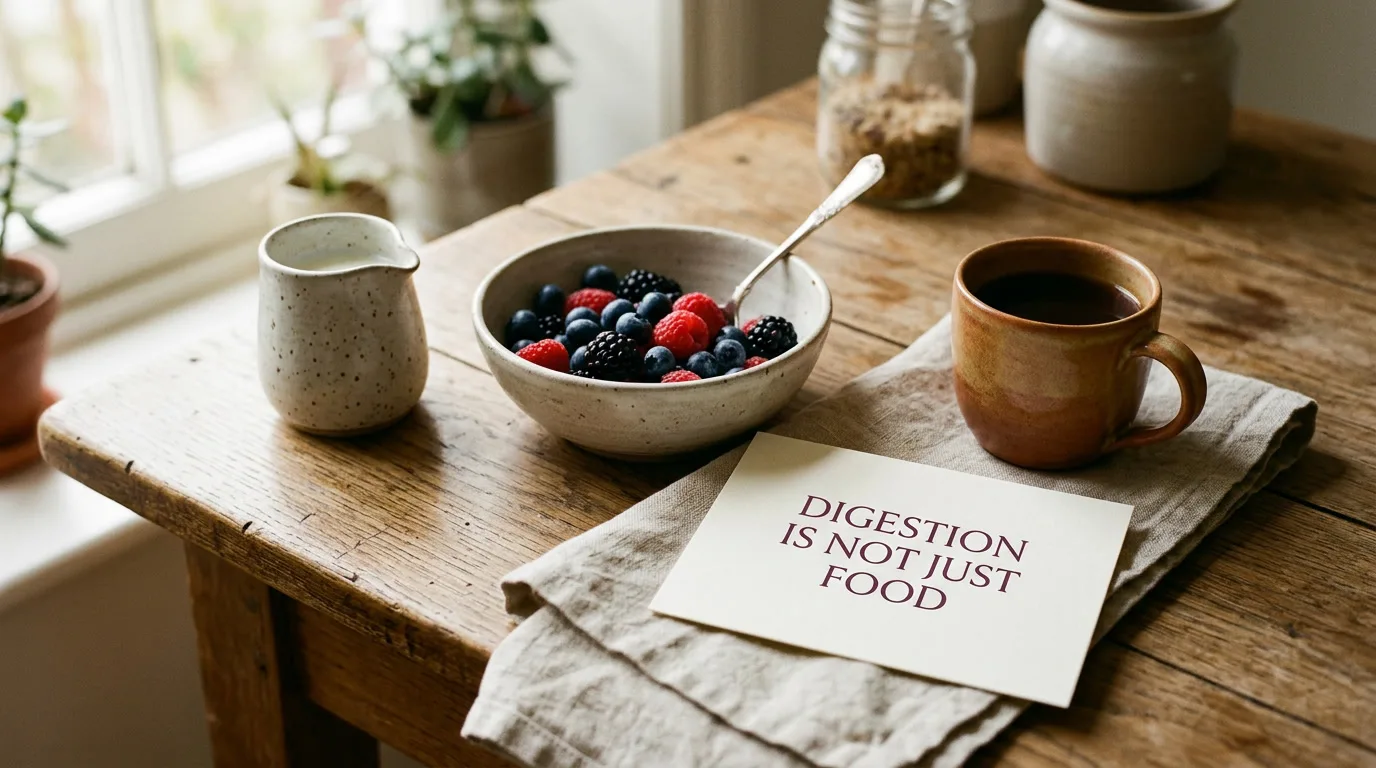
I once sat beside a friend who ate lunch standing up, phone in one hand, a meeting starting in four minutes, and then told me she had no idea why she felt so heavy all afternoon. Nothing was wrong with her food. Something was wrong with the conditions around it. That is the small, unglamorous territory we are walking into here: not what you eat, but how you are built to take it in. In Human Design this layer is called Digestion, or Determination, and it sits at the top left of your chart as one of the four arrows. It is also, quietly, one of the most practical things in the whole system.
Digestion is not just food
In Human Design, Digestion describes the conditions under which your body takes in what it needs and lets go of what it does not. The system treats food and information as the same kind of event. A meal, a conversation, a page of a book, an hour of scrolling: all of it has to be received, broken down, and then either absorbed or released. If your body has a preferred way of doing that with lunch, it very likely has a preferred way of doing it with ideas too.
That is the part most of us miss. We fuss over what we eat and almost never ask how we are eating it.
Where this sits in your chart
Digestion is one of the four Variables, the arrows across the top of your chart. The top left arrow is Determination, the top right is Environment, the bottom left is Perspective, and the bottom right is Motivation. If the arrows are new to you, I have written a gentle introduction to the four arrows and what they describe, and it is a good place to begin before you go deeper here.
On the chart, the arrow points left or right and carries a colour and a tone. The practical layer, the one you can actually live with, is the twelve keys. You do not need to understand the arithmetic to use them. You only need to recognise which description makes you exhale. If you do not have your chart yet, you can generate it here for free and come back with the arrow in front of you.
Twelve keys, not twelve rules
The twelve keys usually come in pairs, and each pair is a spectrum rather than a verdict. Hot and Cold. Direct and InDirect. High and Low. Calm and Nervous. Then four that describe simplicity and choice: Alternating, Consecutive, Closed and Open. Read them slowly. One of them will sound like your body, and one will sound like the advice you have been failing to follow.
That gap is worth noticing, kindly.
Temperature: Hot and Cold
If temperature is your key and you sit on the Hot side, your body asks for warmth. Liquids above body temperature, meals that have already been manipulated, which is to say cooked, stewed, baked, transformed by heat. A cold salad on a cold day can look virtuous and leave you vaguely unsatisfied. It is not about virtue. It is about the conditions your system needs in order to extract anything from what you give it.
On the Cold side it runs the other way. Cooler drinks, and food as close to its own nature as possible: raw, fresh, lightly handled. You may have noticed that a heavy cooked meal sits in you like a stone, or that you feel clearest in the morning after something simple and cool. The system would say you are not difficult. You are specific.
Temperature is emotional too, if you think about it. Some conversations need heat. Some need to cool down before anything can be absorbed.
Light: Direct and InDirect
Light, for the Direct key, means direct light. Daylight, or a bright lamp in the evening. You take in more when the room is open and bright rather than dim and shaded. If you have ever felt inexplicably better after moving your desk to a window, this may be part of why.
InDirect is the opposite and just as valid. Indirect sunlight during the day, soft lamplight at night, nothing glaring straight into your eyes. Harsh overhead light can make you close down without knowing why. Notice where you actually eat, not where you think you should.
Light is the quietest of the keys. Nobody puts it on a list of healthy habits, and almost everyone notices it last.
Sound: High and Low
High means you need sound around you, and preferably company. Conversation while you eat is not a distraction for you, it is part of how the meal lands. Silence can feel oppressive.
A busy kitchen, a radio, people talking over each other: that is not chaos, that is your digestion working. You are not being rude by keeping the conversation going. You are eating.
Low asks for quiet. Real quiet, or a very particular amount of it. You may find that you cannot talk and eat at the same time without losing track of both. A noisy lunch leaves you full and empty at once. This is not shyness. It is bandwidth.
Company: Calm and Nervous
Calm is about stimulation, not volume. You need to be still, or alone, or in a room that does not ask anything of you while you eat. Eating at your desk with three tabs open is the opposite of what your body is asking for. The meal is not the only thing being digested.
Nervous is the other side: you need movement or visual life. You eat better standing, walking, or in a place where things are happening and people are around. Being told to sit still and chew slowly can feel like being asked to hold your breath. Your system takes in more when there is a little life in the room. If you are sensitive to the energy of others, there is more about that in open centres and conditioning.
Simplicity and choice: the last four
Alternating and Consecutive both point to simplicity, and they differ in rhythm. Alternating asks you to move between different foods without mixing them, one after another, keeping the plate simple. Consecutive asks for one ingredient at a time, prepared one after the other. In both cases the instruction underneath is the same: do not make your body untangle a knot at every meal. Fewer things, in a clear order.
Closed and Open are about choice. Both need a table with options, because being forced into a meal you did not choose is the thing that costs you most. The Closed key then prefers the familiar, the known, the thing you already love, and does not want to be pushed into novelty. The Open key wants to keep trying new things, as long as nobody makes it eat what it does not like. Same need for choice, different appetite for surprise.
The same key, applied to information
Now take the same key to your information. If you are Low, a meeting where six people talk at once will leave you with nothing you can use, and a quiet hour with one document will give you more than a whole conference. If you are High, you think best out loud, in company, with noise. If you are Calm, you need to read alone before you discuss. If you are Nervous, a walk with a voice note beats a desk.
None of this is discipline. It is fit. I wrote separately about how this plays out at work.
Try it with something you have been avoiding. A book, a form, a difficult email. Change the conditions, not the content.
The layers underneath: tones, colours, left and right
Underneath the twelve keys there are further layers, and I want to be straight with you about them. The system names six tones (Smell and security, Taste and uncertainty, outer Vision and action, inner Vision and meditation, Feeling and judgement, Touch and acceptance), six colours (Appetite, Taste, Thirst, Touch, Sound, Light) and a left or right orientation. In the material I work from, these are labels and keynotes rather than paragraphs of instruction, and I am not going to invent meanings for them to sound thorough. They are refinements for a reading, not homework for a Tuesday.
What I will not tell you
I also want to be clear about what this is not. Digestion in Human Design is not a diet, not a diagnosis and not medical advice. There is no independent clinical research behind the twelve keys, and I will not pretend otherwise. If you have pain, reflux, an eating disorder or a gut condition, that belongs with a doctor. What the system offers is a language for noticing, and permission to stop forcing your body through conditions that were never yours. Treat it as an experiment, not a treatment.
How to tell which key is yours
Do not start with the chart. Start with a memory. Think of a meal after which you felt genuinely well, not just fed. Where were you, what was the light doing, was it loud, were you alone. Then think of one after which you felt heavy or restless, and ask the same questions. Most people find their key in that contrast within a minute, long before they can read the arrow.
The chart is confirmation, not the source. It is a map someone drew of a landscape you have been walking your whole life. When the description matches the memory, you will feel a small, quiet yes somewhere in your body. That yes is worth more than my explanation. Keep it.
If you want the wider picture of how your body and your energy work together, the nine centres will give you the next layer.
When your key meets someone else's table
Here is where it gets tender. Most of us eat with other people, and other people have their own keys. The one who needs quiet marries the one who needs talk. The one who needs warm cooked food shares a kitchen with someone who thrives on raw and cold. Nobody is being difficult. Two bodies are simply asking for different weather in the same room.
You do not have to solve that by eating alone forever. A little honesty helps more than a rule. I like warm food and a quiet table, and I would rather have that than be polite about a salad I did not want. Said kindly, that is not a demand, it is information. If you want to go deeper into how different designs share a life, relationships in Human Design is the place to start, and it is written for exactly these small negotiations.
A week of small experiments
So here is a week. Pick one meal a day and eat it under the conditions your key describes. No other change. Notice three things afterwards: how full you feel, how clear your head is, and whether you wanted more. Then try the same conditions with one piece of information, a chapter or a meeting. This is exactly the kind of slow, unspectacular work that deconditioning is made of.
One meal. One week. That is the whole assignment.
And if you want company while you experiment, that is what I am here for. A personal reading can put your Digestion next to your Type, your Authority and your Environment, so you can see how the pieces lean on each other. You do not have to get it right on your own. Most of us learn this by being witnessed, gently, while we try.
How I Can Help
Four ways to explore and live your Human Design, whether you're new or ready to go deeper.


Curious about your own design?
Generate your free Human Design chart and discover your Type, Strategy, and Authority, the first step toward living in alignment with who you truly are.
Get Your Free Chart