
The Open Head and Ajna: When the Thinking Isn't Yours
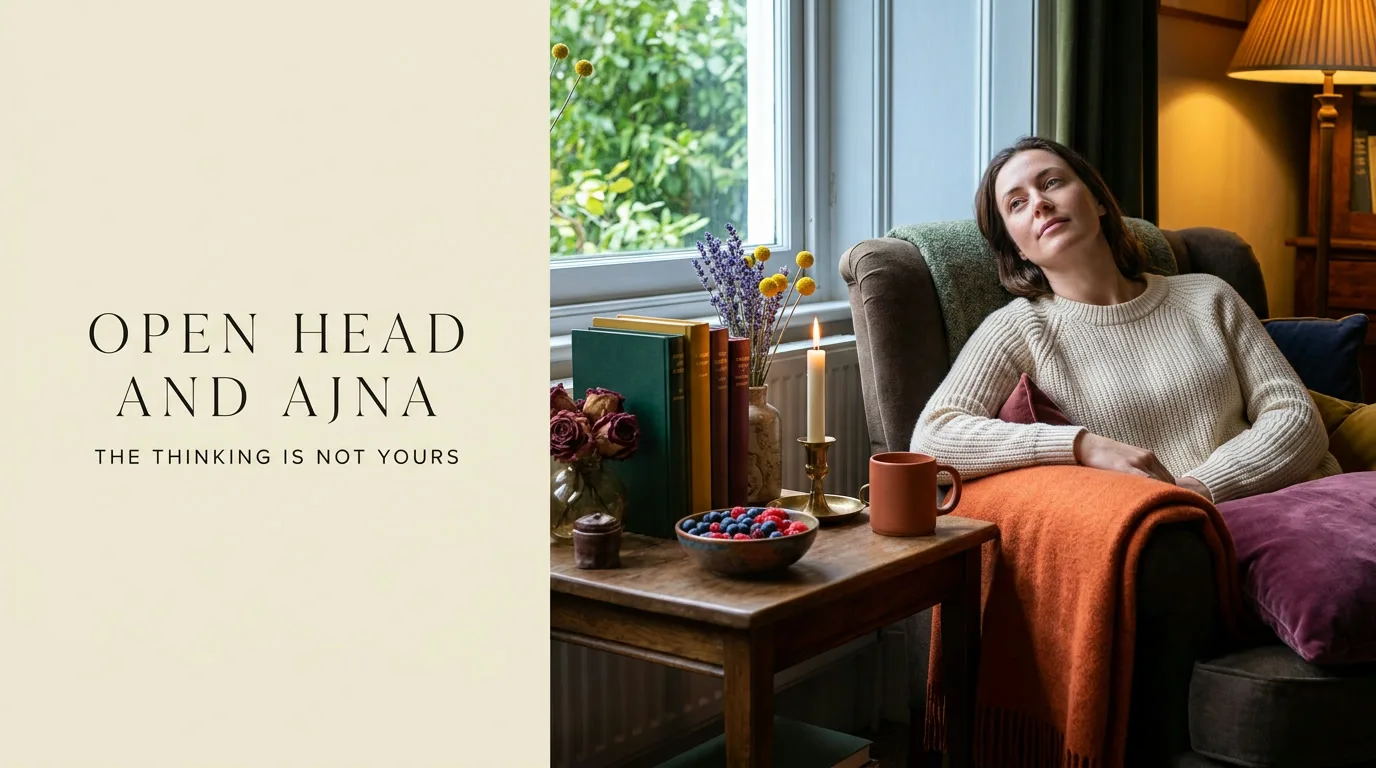
It is well past midnight and you are still inside a conversation that ended hours ago. Someone asked you a question in a meeting, you answered, and now you are turning the answer over looking for the crack in it. Or you are lying awake beside someone who is already asleep, running through a list of things you do not know, have not been asked to solve, and cannot put down. There is a particular tiredness that comes from thinking which does not feel entirely yours. It arrives with a question attached, or an opinion you did not build and are suddenly defending. If you have ever felt stupid for not knowing something on the spot, or agreed with three different people in one afternoon and meant all three, then you already know the territory of this post.
In Human Design the two mental centers, the Head and the Ajna, describe exactly this. They are the parts of the chart that handle questions and answers, inspiration and opinion, pressure and packaging. When they are open, which is common, you spend a large part of your life thinking thoughts that started somewhere else.
Two centers, one job
The Head center sits at the top of the chart. Its subject is pressure: the pressure to know, to be inspired, to get an answer to a question. It is where a question lands before you have decided whether you even care about it, and where mental energy is generated rather than stored. You can think of it as the place a thought begins, before it has any shape at all.
The Ajna sits directly underneath and does something different. It takes what the Head delivers and makes sense of it: concepts, opinions, beliefs, the way you package information so it can be used. If the Head is the question, the Ajna is the shape you give the answer. Both are awareness centers. Neither one is a motor, and neither one moves you toward anything.
Which is worth saying plainly, because most of the confusion about these two centers comes from us expecting them to do a job they were never given.
What open actually means
An open center is not an empty one, and that is the first thing I want to clear up. In the chart, an undefined center is one where you do not generate that energy consistently yourself. What you do instead is take it in from the people and rooms around you, and then amplify it. The mechanism is closer to a very good microphone than to a hole in the floor. You do not lack a mind. You have a mind that picks up what is in the air and turns up the volume. The mechanism is described in more detail in the piece on how conditioning works.
That is why a question asked in a flat voice can feel like an emergency, and why a room full of certainty can leave you unable to hear your own view.
The borrowed question
It usually starts small. A colleague wonders out loud whether the project is behind, and within a minute you are the one holding the worry, checking the timeline, feeling responsible for an answer nobody actually asked you for. The Head is open, so the question came in at full strength and stayed.
Then there is the family version. A parent's unspoken worry, a friend's endless what if, the group chat that turns one person's restlessness into everyone's task list. You read it, you feel the pull to solve it, you draft a reply in your head at eleven at night. Nobody appointed you. The pressure simply arrived and made itself at home, and because it was loud you assumed it was yours.
Here is the useful question, and it is almost embarrassingly simple: did this arrive with the room, or did it arrive with me?
The borrowed certainty
The Ajna works the same way with opinions. When it is open, you take in other people's certainty and amplify it, which means you can become fluent in a position you did not build. You hear a strong argument at lunch and by evening you are making it yourself, with conviction, at the dinner table. Someone states a firm view about how the world works and something in you settles into it, because their certainty is doing the job yours was never meant to do on demand.
The other side of this is a genuine gift, and it comes with a cost. You can hold many viewpoints at once, see why the person on the left is right and why the person on the right is also right, and mean both. Asked to pick, you can feel the structure wobble, not because you are confused but because you are seeing more than the question allows for.
When it becomes overthinking
In Human Design the not-self theme of an open Head is a mind that never stops asking. The not-self theme of an open Ajna is a mind that never lands. Together they produce the thing most of us simply call being in our head: the loop, the replay, the answer that is never quite good enough to put down. If you want to see the nine centers in context, the whole map is in the guide to the centers.
It can look like performing certainty you do not feel. You say of course, absolutely, that makes sense, while something in you is still checking. It can look like research that never ends, because one more source might settle it. It can look like needing an opinion the moment a topic comes up, as though not having one were a small public failure.
The part that is genuinely difficult
I do not want to sell you openness as a pure gift and skip the hard part. A day of meetings can leave you more depleted than a day of physical work, and there is no visible reason for it.
There is also a social cost, and we all recognise it. People who are quick and certain get rewarded, and if your mind is built to hold several possibilities at once, you can be read as vague, indecisive, or not quite committed. That reading is wrong, but it lands, and after enough of it you start to defend yourself by producing opinions faster than you can actually form them.
There is another tiredness too, harder to talk about: the tiredness of always being the one who understands. If your mind takes in everyone's perspective, you can become the person who holds the conversation together and makes sure nobody feels foolish. That work never shows up in a calendar, and it is almost always the one with open mental centers who does it.
The relief, when it comes, is not that you become decisive overnight. It is that you stop treating the pressure as a personal defect.
What an open mind is actually for
Here is the part I would love you to hear. A defined Ajna is fixed, and its gift is a stable point of view. An open Ajna is not fixed, and its gift is range. You are the person who can sit with a room in conflict and understand every side without betraying any of them, because your mind is not holding a position it has to protect.
That is a form of intelligence the world keeps undervaluing, because it does not look like certainty. It looks like listening, like the colleague who asks the question everyone missed, or the friend who can describe your situation from three angles and still does not tell you what to do about it. You are wise about thinking precisely because you are not welded to one way of it. That does not mean you have no judgement. It means your judgement forms in the meeting, rather than existing finished before the conversation begins.
You are also not designed to be certain on demand. That sentence is worth sitting with.
Small experiments, nothing dramatic
I would love to invite you to start with the pause before the answer. When a question lands and you feel the familiar rush to fill the silence, wait three breaths and ask yourself where the urgency came from. If it came in with the person, you do not have to carry it out with you.
Then try a sentence that will feel strange the first few times: I do not know yet. Not I do not know, which closes the door, and not a guess offered to keep everyone comfortable. I do not know yet, which is honest and leaves the question where it belongs for now. Most people discover that the room survives this perfectly well, and that a surprising number of conversations get better once someone stops pretending to be finished.
Third, notice what happens to your opinions when you change rooms. Spend an evening with people who hold strong views and then write down what you actually think before you speak to anyone else. The gap between the two is information, not hypocrisy. It tells you which parts of your thinking were borrowed and which held.
And if you want to see the mechanism in your own chart rather than in the abstract, reading your chart shows you how to find which centers are colored and which are white, and what to do with that knowledge.
The mind does not make your decisions
One more thing, and it matters more than anything else here. Neither the Head nor the Ajna is a decision-making authority. They are awareness centers: they notice, they consider, they present options. They do not choose. A mind can build a perfect argument for a life that is wrong for you, and talk you out of a life that is right.
Your decisions come from somewhere else, and your authority is where that conversation belongs. The mind's job is to be a good advisor. It is a terrible boss. When the pressure gets loud it can feel like anxiety, and not all of what you feel is yours is about what open centres take in.
A gentler relationship with your own head
If you have read this far and recognised yourself, I want to leave you with something softer than a technique. Your open Head and Ajna are not a design flaw and not a diagnosis. They are why you can walk into a room and feel what is being thought before anyone says it, and why you can be trusted with a perspective that is not your own.
Give yourself permission to be someone who thinks slowly and says so. We need more people who let a question ripen instead of filling the silence, and I suspect you already are one of them. Give yourself permission to leave a question open overnight. The people who matter will still be there in the morning, and the answer, when it comes, will be more yours for the waiting.
If you have not seen your own chart yet, you can generate it here, for free and simply look at the top two centers. Colored or white, it is not a verdict. It is a description of how your mind meets the world, and it has been doing that faithfully your whole life.
Nya inlägg
En lugn signal när ett nytt inlägg publiceras. Högst en om dagen.

Next step
Practical Guidance Report · Skriftlig rapport
If you want it more grounded, tied to daily life, there is a practical report with what you can actually do differently.
Order · $219Written report · read at your own pace
New here? Get your free chart
Your chart, in your pocket
Your chart, today's transit and my latest posts, all in one place.
Get the app
Read next
 Centers
Human Design and Anxiety: When What You Feel Is Not Yours
Some of what you carry was not generated in you, it was taken in and amplified. Here is what the open centres do with questions, urgency and moods, how to notice the difference in the moment, and why openness is not something to close down.
10 min read Practical
How to Read Your Human Design Chart: A Clear Order
Opening your chart can feel like a lot. There is an order that makes it make sense, and it starts with the few parts that actually change how you live. We walk through type, strategy and authority, then the centers, the profile, the channels, the gates and the incarnation cross, and how to turn the chart into a week you can really use.
12 min read Centers
Open Centers and Conditioning: When Other People's Energy Becomes Your Own
Your open Centers are not a flaw; they are where you amplify other people's energy and build your deepest wisdom. Here we walk through what conditioning is, how to recognise the quiet question of what is actually yours, and how to carry your openness as the gift it is.
11 min read