
Who You Are When Nobody Watches
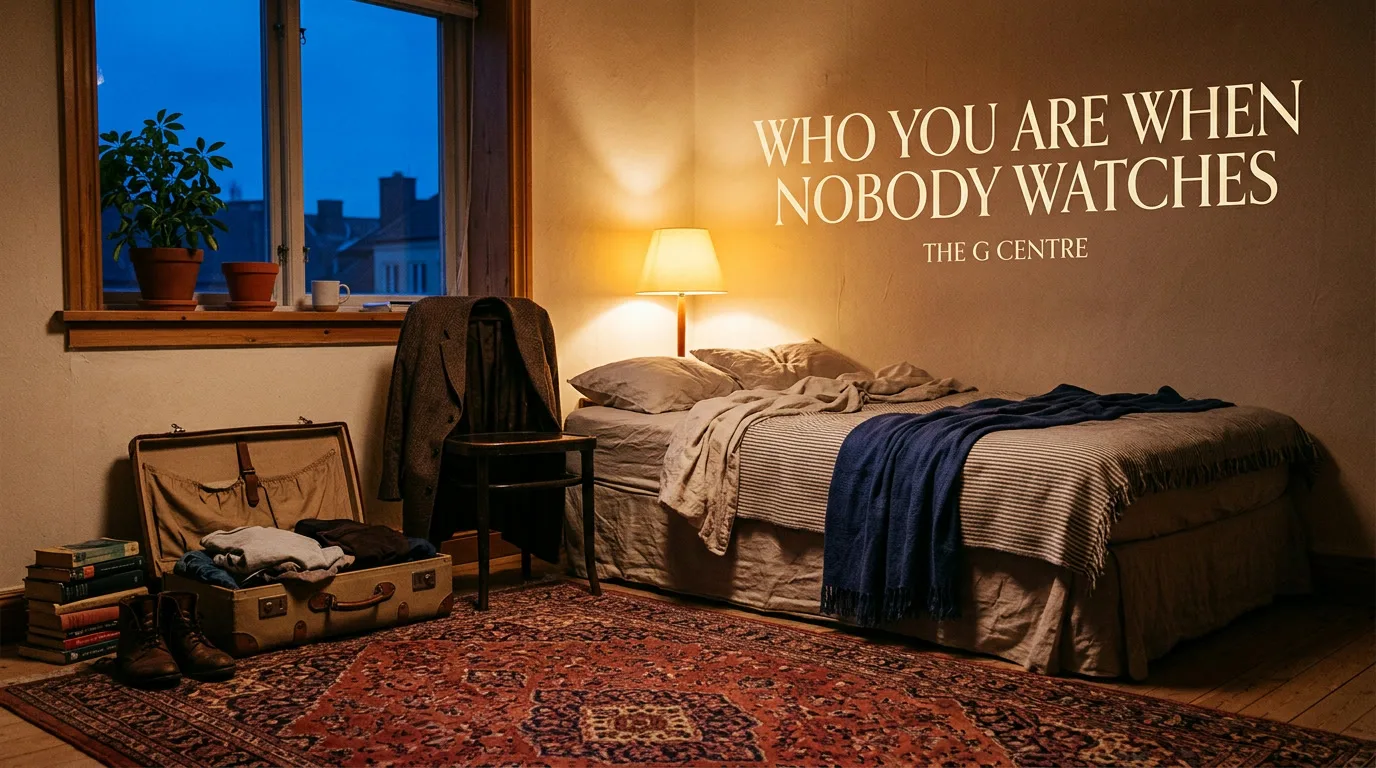
The last sound in the hotel room is the door closing. The bag stays on the floor, the coat hangs over the chair, and the room is suddenly only a room. No one comes in, no one waits for an answer, no one asks what you think. A week of meetings ends in that small second, and what stays is a pair of shoes no one has looked at all day.
Something happens in that moment. The shoulders drop a centimetre, the breath goes deeper, and the conversation from the lobby loses its receiver. The tone that sat in the body all week has no one to play for now. Perhaps you notice you do not know what you want to eat, what you think of the city, or which version of you came here.
Being lost is something else. Lost assumes a place you should be in, and a map someone else drew. There is no such map here, only a room that does not answer. What remains is a question about how much of the face came from the mirror, and how much was there before. The room is quiet, and that is what makes the question audible.
The room that emptied
A week of conversation can make this clear. You laugh in the right places, nod when someone suggests a restaurant, and check what others seem to want. It all comes easily, almost without effort. In the evening you sit with a smile no one asked for, and wonder where it came from. Then the door closes. What remains is not emptiness first of all, but a question about whose voice spoke a moment ago.
In Human Design this is described through the nine centres, and one of them is about that question. It is called G, and it is where identity and direction live.
The centre is not a personality and not a script. It is a function in the body graph, and can be coloured or white. For someone who has always known who they are, the question sounds strange. For someone who has never felt a fixed point, it is everyday life.
The middle of the chart
The G centre sits in the middle of the body graph, surrounded by the other centres, and it is the hub of identity and direction.
Direction here is not a goal in the calendar. It means the inner compass that makes a step feel like your own, even when no one else sees it or agrees. It shows in small things: which room you look for at a party, which work outlasts the enthusiasm, which city lets the body breathe. It shows when it is missing too, like a thread without an anchor.
On your own chart the centre appears in the middle, coloured or white. The colour says something about how identity works, not how much is there. Identity in this sense is not the same as personality. Personality is the way you speak, joke and move through a room. Identity is the point all of this moves around, and that point can be fixed or movable. Two people can laugh alike and carry completely different ground.
The coloured middle
A defined G gives a steady experience of identity and direction. It stays when the conversation changes tone, and does not need the room's agreement to hold. A person can walk into a room full of opposite opinions and come out with their own intact.
That does not make it motionless. A defined identity can change its expression, change city, change work, and still be recognised inside. The direction can be adjusted without the ground moving, like a tree that loses its leaves but keeps its roots. Someone who recognises themselves needs no confirmation at each step, and can listen to others without losing footing. It can also mean the person rarely explains themselves. The direction is clear enough not to need a defence.
That quiet is often read by others as safety. Someone who knows who they are does not have to win every conversation about it, and can leave a room without correcting anyone.
There is a loneliness in that too. Being certain inside can make it hard to explain why a path feels right when no one else sees it. Someone with a defined G can still doubt, and the doubt can be deep. The difference is that it does not take over the ground. The person can wonder about a choice and still know who is wondering.
The open middle
A white G works in another way. It takes identity and direction from the place and from the people present, and does so all the time, without asking permission.
It can feel as if the form changes in different rooms. A city gives one tone, a friend gives another, and after an evening with someone you can hear that person's words in your own mouth. It is not a lie and not adaptation in a bad sense. It is how the centre reads, faster than the mind can describe. That is why an afternoon in the wrong company can feel like a different day altogether.
Here is what is called open centres and conditioning, and it describes mechanics, not character. The difference matters: it moves the gaze from the person to the situation. Nothing went wrong in the upbringing. An open centre does what an open centre does, mostly without words. The consequence shows in daily life. You can come home from a dinner and wonder what you thought, or notice that a decision felt obvious in one room and foreign in the next.
It is not indecision, and it is not weakness. A centre does its work, and the work costs energy. To keep taking in and adjusting can leave a tiredness that sleep does not remove. Someone open therefore needs time alone, as recovery rather than escape. The picture clears slowly once the room has gone quiet.
The question that returns
Who are you when no one is watching?
The question appears in the car home, in the lift, in the second before sleep. It is not a sign that something is missing. It is a sign that the centre is working, reading the room and testing what fits. There is a difference between no fixed identity and no identity at all. The open side has an identity, but it is movable. It takes the shape of the vessel without ceasing to be the same water. The question is about form, not existence.
The question is easy to hear as a problem. Many carry it for years and wait for an answer that will hold in every room.
The answer rarely arrives as a title or a profession. Often it shows as a feeling that a place no longer fits, or that another place suddenly makes everything easier. The question can be asked more softly, without demanding a solution. Then it becomes a description of what is happening in the room, and a reminder that direction often comes from outside first.
The difference from emptiness
An open identity can feel like emptiness when no one is in the room. It is easily read as a lack, especially in a society that praises a steady personality and a clear answer to who you are. Many learn that a person should know, and that hesitation is a sign something went wrong early.
But emptiness and openness are different things, and they only feel alike when you stand in them. Emptiness lacks direction even when someone is present. Openness takes direction from what is present.
It can see the quality of a situation before anyone else finds words for it. It senses that a room is heading the wrong way, or that a person carries something unspoken. Learning the difference is part of deconditioning. It happens slowly, by noticing which rooms make you wider and which shrink you. The body holds the difference even when the mind doubts.
There is nothing here to repair. An open G belongs to the construction, and there is no door to close. There is a function to understand, and a life that needs to choose its rooms. That care is not a weakness. It is a skill.
The place that carries
There is a gift in the open side that rarely gets a name. It sees what fits, not because anyone says so, but because something in the body responds before the mind catches up. It makes the choice of place more than a practical detail. Environment and its direction affect how an open G feels itself, and for that side the question of the room is not academic.
A flat with the wrong light can make a winter greyer. A kitchen where someone cooks can make an ordinary Tuesday soft.
So an open G can flourish in a setting no one else understands. The person fits the place, and the place fits the person. The wisdom here is about surroundings, not an inner voice that always knows. Someone open to identity learns to read a room early. They sense who carries and who drains, and know when a place gives more than it takes. That is knowledge about the world, not a lack of self.
Direction often shows in hindsight, when a room has left its trace and the body can feel what stayed. Someone who has lived long with an open G knows the signs: a relief in the chest when the door opens, a tightening when the conversation takes a certain tone.
The signs are small, and they are reliable. They point to a place, a person or a setting, and rarely need an explanation to be trusted.
The room that fills again
Then comes the evening when the room fills again. Someone calls, someone waits, and identity once more takes a direction from outside. It is neither defeat nor liberation, only a centre doing its work. The question is not whether it happens. The question is what gets to steer. It shows most clearly in close relationships. There the open side turns soft, and can mirror another person's wish so well that its own is forgotten for a while.
It is a gift when it is used with awareness, and a cost when it is not. Love can carry a great deal, but it cannot decide whose direction applies.
A child who moves to a new school shows the same thing. At first the form is unclear, then the body finds a place in the room. After a while there is a direction that was not there before. It grew out of the encounter, out of the desk by the window, out of the name someone remembered. It comes into being in company, and is not less real for having come from outside first.
An adult life holds many such rooms. Some give steadiness, some make the question loud, and some are only corridors where no identity has time to settle. Not all three need solving. What remains when the door closes is not an empty shell. It is a person who can recognise themselves in several settings, and gets to choose which one carries the next step. The room is quiet, and you are still here.
Nya inlägg
En lugn signal när ett nytt inlägg publiceras. Högst en om dagen.

Next step
In-Depth Report · Skriftlig rapport
This part is connected to the whole. An in-depth report goes through the chart properly, written from your details, not automatically generated.
Order · $165Written report · read at your own pace
New here? Get your free chart
Your chart, in your pocket
Your chart, today's transit and my latest posts, all in one place.
Get the app
Read next
 Variables
Your Environment Arrow: The Place Where You Actually Thrive
Have you ever walked into a room and known immediately that you could not work there? Human Design gives that its own variable. Here are the six environments, left and right, and how to find yours without guessing.
15 min read Centers
Open Centers and Conditioning: When Other People's Energy Becomes Your Own
Your open Centers are not a flaw; they are where you amplify other people's energy and build your deepest wisdom. Here we walk through what conditioning is, how to recognise the quiet question of what is actually yours, and how to carry your openness as the gift it is.
11 min read Personal Growth
Deconditioning: How to Find Your Way Back to Yourself
Deconditioning is the gentle process of coming back to yourself, layer by layer. Here we look at conditioning, the Not-Self theme and signature for each Type, why awareness comes first, and how to release borrowed patterns without turning healing into another performance.
15 min read