
Your Environment Arrow: The Place Where You Actually Thrive
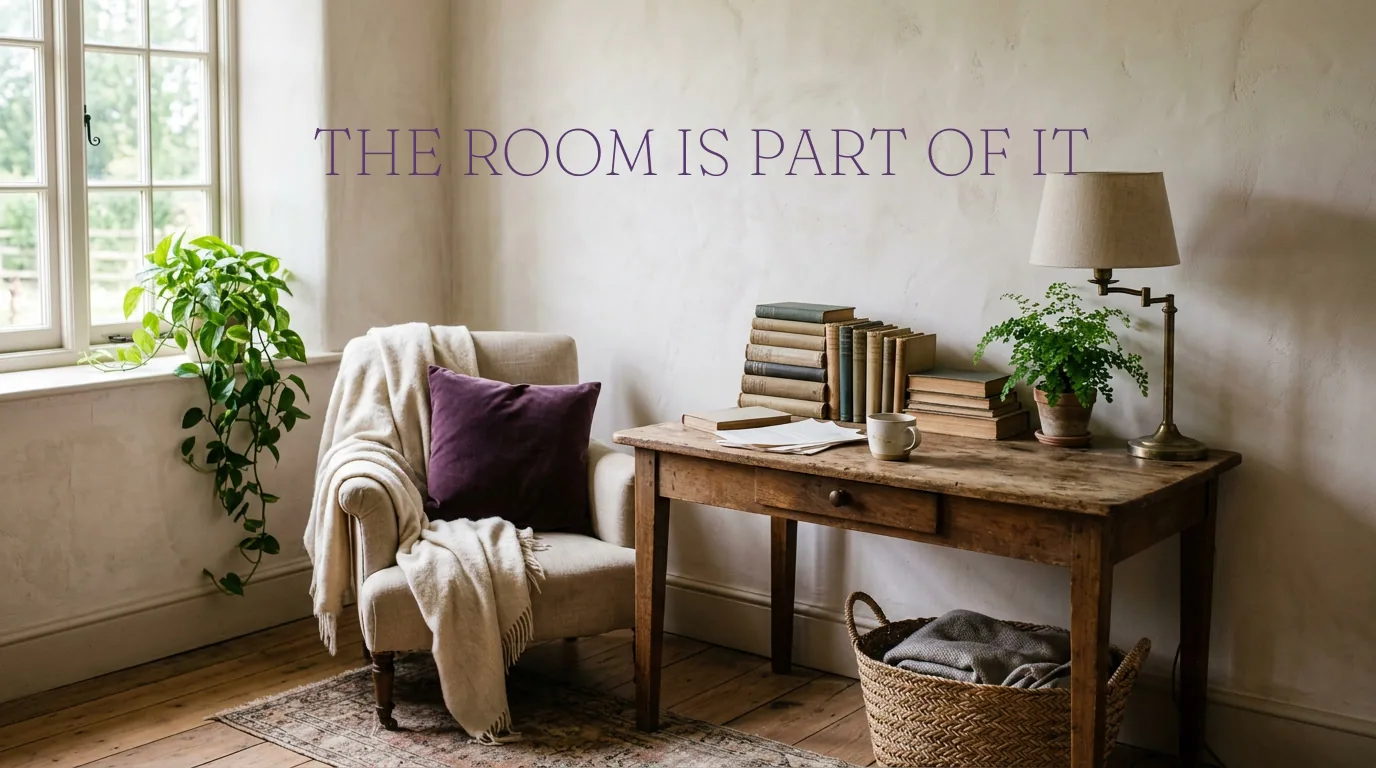
You have probably had the experience of walking into a room and immediately knowing you could not work there. Nothing was wrong with it. The light was fine, the chair was fine, the wifi worked. And yet something in you had already closed the laptop before you sat down.
Most people write that off as a mood. Human Design takes it seriously enough to give it a whole variable of its own.
Environment is the arrow that describes where you thrive, and it is one of the four that sit at the very top of your chart. It is also the one people skip, usually because it sounds too simple to matter.
Where the environment arrow sits in your chart
At the top of your BodyGraph there are two sets of numbers, one on the design side and one on the personality side, each with a sun, an earth and two nodes. Those four positions produce the four arrows, which are sometimes called the Variables.
The arrows are not extra decoration on top of your type. They describe the way your type operates in the world, which is a different and more granular question than what kind of energy you run.
Environment comes from the design nodes. If you have seen a chart with four little arrowheads beside the coloured centres, the second one from the left is the one we are talking about.
The four arrows cover how all of them fit together. This post goes deep on just this one, because it is the most practical of the four and the easiest to test in an ordinary week.
The six environments
Human Design describes six environments. They are not literal instructions to go and live in a cave or on a beach. They are descriptions of the kind of space that lets your nervous system settle, and you will usually recognise yours faster than you expect.
Caves
Caves are enclosed, protected and a little withdrawn. If you are a Caves person you do your best thinking in a small room with a door that closes, and you feel exposed in open-plan spaces even when nobody is looking at you.
The practical version is not a literal cave. It is a corner, a nook, a room at the back of the house, a seat facing a wall. Somewhere the world is not coming at you from four directions at once.
Markets
Markets are the opposite. You come alive where things are moving and there is a bit of noise and choice in the air. A busy cafe, a co-working space, a train, a kitchen with people in it.
If this is you, working from home in silence may be quietly draining you, and you may have blamed yourself for not concentrating rather than noticing you were in the wrong kind of room.
Kitchens
Kitchens sit between the two. They are warm, active and social, but on a human scale rather than a crowd. The centre of a home rather than the centre of a city.
People with a Kitchen environment often do their real talking standing up, with a cup in their hand and something on the stove. Sitting across a formal table feels stiffer to them than it does to everyone else.
Valleys
Valleys are low, wide and open, with a sense of being held by the land rather than exposed on top of it. If you are a Valley person, you may find that a view from a height feels wrong, while a view from the bottom looking up feels like home.
Mountains
Mountains want elevation, overview and a certain amount of distance from the noise. Not necessarily altitude. A top floor, a rooftop, a hill, a room with the long view.
For Mountain people, being at ground level in a dense place can feel oddly claustrophobic in a way that has nothing to do with the size of the room.
Shores
Shores are the edge, where one thing meets another. Water and land, inside and outside, the boundary itself rather than either side of it.
If you are a Shore, you may find you are happiest in transitional spaces, near a window, on a threshold, at the edge of a group rather than in the middle of it.
Left and right: how you meet the space
Each environment also has a direction, left or right, and this is where people get lost, so it is worth being clear about what it does not mean.
Left is often described as focused and strategic, right as receptive and aware. A left environment wants the space arranged deliberately, with things where they should be. A right environment notices the space rather than arranging it, and can be thrown by a room that is subtly wrong without being able to say why.
Neither is better. They describe two ways of relating to a room, not two levels of ability.
If you are right-environment, the practical advice is to trust the noticing even when you cannot justify it, and to give yourself permission to move to a different seat without explaining yourself to anyone.
Why this matters more than it sounds
Here is the part that is easy to miss. Environment is not about aesthetics and it is not about comfort. It is about how much of your energy goes into managing the space instead of doing what you came to do.
A Caves person in a busy open office spends the whole day bracing. A Markets person alone in a quiet house spends the whole day looking for something to spark against. Both of them finish the day tired, and both of them usually conclude that the problem is them.
It almost never is.
This connects directly to how your energy works. An open centre takes in and amplifies what is around it, which means a badly matched environment costs a person with several open centres far more than it costs someone with a densely defined chart.
How to find yours without guessing
You can read it off your chart, and you should, but the reading is only half of it. The other half is noticing, and noticing is the part that actually changes anything.
Start with memory. Think of three places in your life where things went unusually well, and three where you consistently struggled, and look at what kind of space each one was. Not how nice it was. What kind of space it was.
Most people find the same shape repeating on both lists, and it usually matches what the arrow says.
Then test it cheaply. Move your desk. Work from a different room for a week. Sit in a different chair at the table. You are not looking for a dramatic transformation, only for whether the small background effort of being there gets quieter.
What it does not mean
The most common misunderstanding is treating your environment as a place you must go and find, as though the correct life is somewhere else and you have simply not moved there yet.
That is not what the arrow says. Almost everyone can work with what they have, in the space they already live in, by adjusting one or two things rather than relocating.
The second misunderstanding is using it as a reason to avoid anything uncomfortable. A Caves person can absolutely give a talk in a large room. They will simply want a small room afterwards, and knowing that is not weakness, it is logistics.
Environment and the people in it
Space is not only physical. Who is in the room is part of the environment, and for some designs it is the larger part.
If you are a Projector or a Reflector, the people around you influence your energy more than your own output does, so a room full of the wrong people will undo a well-designed office. If you want the emotional version of that dynamic, signature and not-self describes the feelings that tell you when you are in the wrong place.
For a Manifestor, the environment question is often about whether a space lets you move, since a room that requires you to sit still and ask permission will cost you more than it costs anyone else.
The honest note about the research
Human Design's variables are the newest and least documented part of the system, and the environment material in particular rests on Ra Uru Hu's teaching rather than on independent study.
I think you should know that rather than have it sold to you as settled science. What I can say is that the experiment is cheap and the self-knowledge is real regardless of where the framework came from.
Treat it as a useful hypothesis about yourself, test it against your own life, and keep whatever turns out to be true for you.
Where it fits next to your type
Your type tells you how your energy is built and how to begin things. Environment tells you where that energy works best. Neither replaces the other.
A Generator can be perfectly correct about saying yes and still be flattened by doing it in the wrong kind of room all week. The signal and the setting are two different questions.
Your authority is what tells you, in the moment, whether a particular space is right. The arrow gives you the vocabulary to understand the answer once you have it.
A small experiment for this week
Pick one room you spend a lot of time in and change exactly one thing about it. The seat, the orientation, the light, what is behind you.
Keep it for a week and notice whether anything gets easier. Not whether you like it more. Whether the effort goes down.
Then look at your chart and see whether the direction you moved in matches your arrow. You can see your chart for free and find your environment in the variables at the top.
If it does match, you have just found a lever you can use for the rest of your life. If it does not, you have learned something more useful than the theory.
Environment at work, where it costs the most
If you want the highest return on this experiment, apply it to the place you work rather than the place you sleep.
Most workplaces are designed for one kind of person, and it is usually the person who can concentrate in a noisy room, sit under fluorescent light for eight hours and be interrupted every twenty minutes without losing the thread. If that is not you, you spend a measurable part of every day compensating, and compensation is invisible to everyone including you.
The useful move is not asking for a private office. It is usually one specific adjustment: a seat facing a wall, a pair of headphones that are socially acceptable, a block of time when you are genuinely unreachable. Small, specific, and easy to grant.
Human Design at work goes further into how type and setting interact on the job, and why the wrong fit feels like a personal failing rather than a design mismatch.
What changes when you stop fighting the room
There is a particular kind of exhaustion that comes from being in the wrong space, and it is different from the exhaustion of hard work. It does not lift after a weekend.
People describe it as feeling flattened, or foggy, or vaguely unreal. They often assume they are burnt out, and sometimes they are, but often they are simply in a room that asks them to be someone they are not, all day, every day.
When the setting finally fits, the change is rarely dramatic. Nothing transforms. You just notice, weeks later, that you stopped dreading a particular hour, or that you no longer need to recover from a normal Tuesday.
That quiet improvement is the whole point, and it is worth more than any theory about arrows. The nine centres give you the vocabulary for why some spaces take more from you than others.
Nya inlägg
En lugn signal när ett nytt inlägg publiceras. Högst en om dagen.

Next step
Personal Meeting (Zoom) · 80 min
If you want to talk this through, tied to your own situation, there is personal guidance over a meeting.
Book · $154Online · recording and summary included
New here? Get your free chart
Your chart, in your pocket
Your chart, today's transit and my latest posts, all in one place.
Get the app
Read next
 Type & Strategy
Your Signature and Not-Self Theme: Your Inner Compass
Every type has a signature, a feeling that shows up when you live in alignment, and a not-self theme that speaks when you do not. Here we walk through all five, how they feel in everyday life, and how to use them as an inner compass.
13 min read Variables
 and the Four Arrows: How to Read Them
The four arrows at the top of your chart say something about how you take in the world: your digestion, your environment, your perspective, and your motivation. Here is a gentle introduction to Variables, and why they come last, not first.
13 min read Practical
Human Design at Work: Finding Work That Fits How You Are Built
Is there a tiredness that has nothing to do with how hard you worked? Here we look at how your Type and authority shape your working life, the three questions worth asking about any job, and what to do when the job is wrong.
14 min read