
The Friends Who Fill You and the Ones Who Empty You
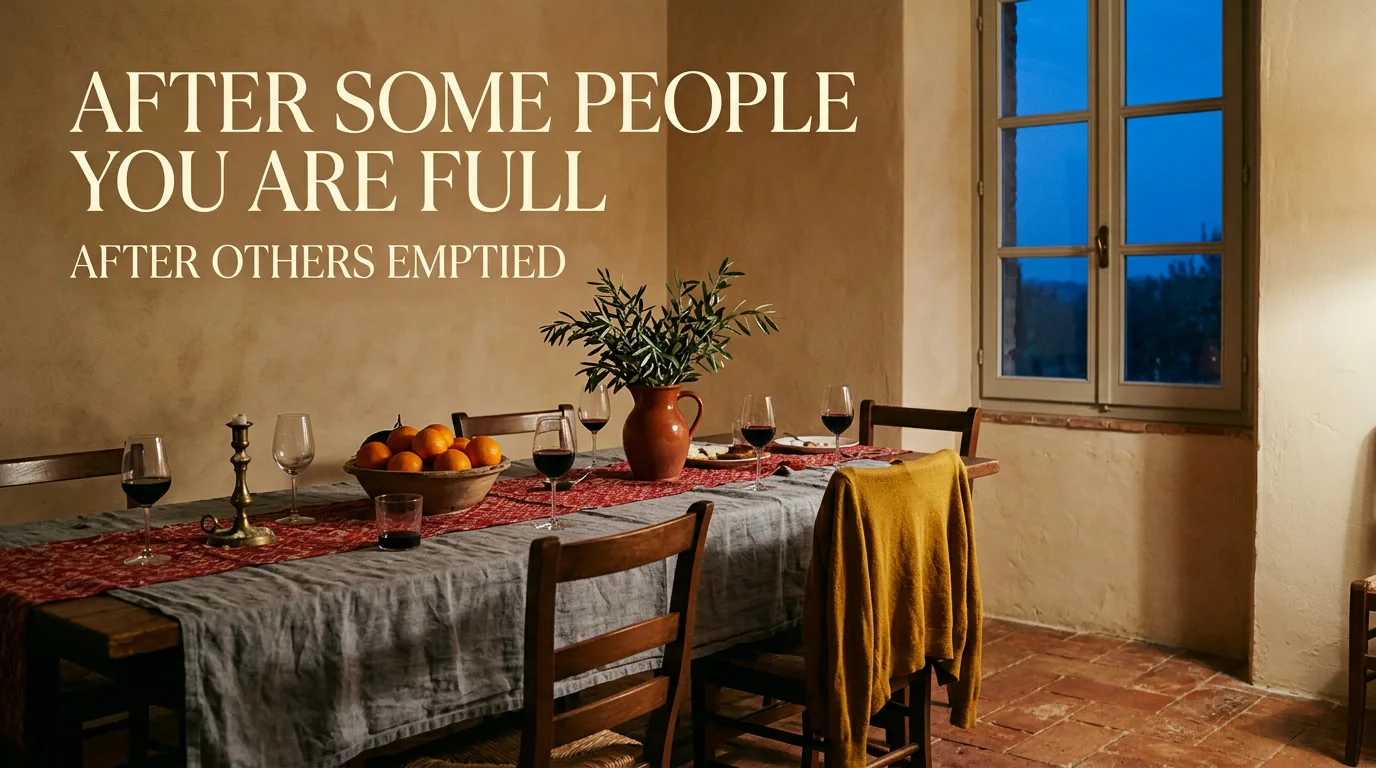
It is late when the front door closes behind you. The evening was warm, the food good, the conversation easy, and still you sit on the stairs for a while before you can face going up. The body is heavy in a way that has nothing to do with sleep. Your thoughts move slowly, as if someone had turned the volume down in the whole system.
Three days later the opposite happens. Another dinner, another kitchen, and you walk home with light steps and talk to yourself the whole way. Nothing in particular happened. Nobody said anything deep. Still there is more room in your chest than when you arrived, as if someone had opened a window in a room you thought was shut.
That difference is the hard one to explain. Both evenings were pleasant, the people were kind in both rooms, and nobody did anything wrong. Yet one evening is like filling a glass and the other is like carrying the glass up a staircase. There is no clear cause to point at, and that is what makes the tiredness hard to trust.
The dinner that does not end
The phone lies on the hall table and keeps lighting up. The group has already started sending pictures from the evening, and someone asks when the next one will be. You read without answering. It is not unwillingness. The room inside you needs to close first. That takes longer than anyone told you. Your jacket stays on the hook and you stand in the hall with your hand on the phone, as if the answer would arrive by itself.
The same thing has happened before. After some dinners you want to reach out already on the bus home, with an idea, a book, a continuation of the conversation. After others the phone stays in the bag for two days. Neither evening was better. It was only about how much of you was left afterwards. It did not show from the outside.
It is possible to live a long time without asking why. Most people do, and it works, until the week when the calendar is full and every evening asks for something that is not there. Then the tiredness becomes something other than tiredness. The body starts counting, and it counts out loud. What used to be one evening among many becomes a debt to be paid.
What fills and what empties
The strange part is that the tiredness does not follow how much you like the people. The friend who talks a lot can leave you lighter than the one who barely speaks. An evening with someone you care about can empty you more than an evening with an acquaintance. That is hard to say out loud.
There is another reading of how two people affect each other, and it begins in the body, in what happens when two energy systems share a room for hours. Neither chooses what will happen. Both arrive with their own construction and their own resources, and the meeting becomes what it becomes. One has a lot to give and gives it gladly. The other takes in what is offered, because that is how they are built. Both are allowed to be as they are.
There is no villain in the room. The one who tops up and the one who receives follow the same construction, with the resources that exist in that body. It helps to know which one is yours, and what it needs afterwards.
The sacral that answers
The sacral centre sits low in the belly and is a motor. In a Generator it is a motor that starts in meeting something, in a response, and keeps going as long as the response is there. The energy arrives in the meeting and withdraws when the meeting ends. It cannot be ordered in advance, and it cannot be saved. Either the response is there, or the motor stands still. It is the body's own answer to what is in front of it.
The energy is no tank that fills overnight. A day with ten small yeses can give more than a day with one big yes that never came from inside.
A Generator working out of duty can go for hours and still end up empty, because the motor is not getting what it needs. The same person can do something small and pointless and come out refreshed, if something in the moment woke a yes. This is the core of the Generator strategy, waiting for the response before the body engages. A room can be full of people and lack the one thing the motor needs. Then it does not matter how pleasant it is.
The Projector's open sacral
A Projector has an undefined sacral centre. Energy comes in waves, withdraws and recharges in quiet, and it holds when the work moves toward something that has been invited. Four hours of conversation can give a Generator more, while a Projector needs to leave before the conversation ends, or the body pays for it the whole next day. The body is not built to hold the same pace all evening. It is no lack of will. It is another rhythm.
Often it is read as coldness. Leaving first, saying no to the after party, putting the phone down in the middle of a sentence. It looks like distance. It is a way of reaching.
Whoever stays behind sees only a back in the doorway and draws their own conclusion. What it cost to leave is not seen by anyone, and nobody asks.
There is another picture of the same evening. The Projector who goes home early leaves the room with their focus still there, and that focus is what makes others feel seen when it is present. The focus is what lets them wait. The Projector's road through invitation is about that rhythm.
The Reflector in the room
A Reflector has all nine centres undefined. That makes them a mirror for the surroundings, and they pick up the mood of a room before anyone has said a word. It is not imagination. That is how the construction is made, and it cannot be switched off for an evening.
The tiredness after a dinner can be borrowed. The Reflector has taken in the pace of the room and the direction of the conversation. The body carries it as if it were their own. That is why an evening can stay for two days.
A Reflector often needs a day that looks like no other day before the picture of the evening becomes clear. What felt heavy at eleven can feel light at three the next day. There is wisdom in that openness, a reading of people that few ever reach. The Reflector's own chapter describes how that reading fits into an ordinary life, with work, family and friends who want different things at once.
The open centres
The same holds for every open centre. An undefined centre takes in other people's energy and amplifies it, roughly like a microphone in a room with loud music. You can feel something that did not start in you: an anger that comes from someone else in the car, a worry that was in the walls when you arrived, a joy that has nothing to do with your day. Silence in a room can carry as much as the conversation.
It is not weakness. The open side is where you learn to read others, and it is the same openness that makes the open centres take in other people's energy with a sensitivity that can be recognised afterwards. Someone with many open centres often notices the mood of others first in the room. A gift in the meeting, and a cost afterwards.
The price is that the line between yours and theirs grows thin. After a day with many people it can be hard to know what is left when everyone has gone. The body notices the difference before the mind does.
A walk, a bath, ten minutes without sound can be enough to hear the difference again. The procedure is short, and it needs no explanation to anyone.
Rest afterwards
There is a time after company that is rarely planned. It does not show in the calendar, and it does not count as anything. Still it is that time which decides how the next day feels. Nobody asks how it was.
A body that has taken in a lot needs to give some of it back, and sleep does part of that work: it sorts what came in and hands back what belongs to someone else. That is why an evening can feel different the next morning. It is as if the room had been washed out overnight. One night can be enough. Sometimes two are needed. The body does this without asking, and it needs to lie still to finish the work.
This matters for anyone with many open centres. Going to bed early after a big day is a way of protecting the next one, and it is allowed without explanation. It is a small act that nobody else needs to see. Sleep and rest by design is about that kind of care.
A glass of water, a closed door, an hour without a screen. It sounds small, and it is, and it is enough more often than expected. The body rarely needs grand gestures after an evening with many people. It needs someone to stop asking anything of it, and for the door to stay shut for a while. It is no large request, and it is the one that makes a difference.
A wider field
There are children who fall asleep straight after a party and children who lie awake for hours. Adults call a friend on the way home, and adults drive the long way past the water to land. None of them is doing anything wrong. They carry different amounts of the room with them.
There is also a question of time. An evening that ends early is not a failure, and an evening that ends late is not proof that something is wrong. What matters is what the body does with the rest of the week. If one dinner costs three days, that is information, not a verdict. In the same way, an afternoon that leaves you with more energy than you arrived with is worth noticing, especially if it did not look like anything special. Many people discover that what they took for a social skill was a habit of staying too long. Leaving earlier can be the thing that makes the next conversation possible at all. There is no point in staying until the room empties, if the price is that you cannot answer when someone calls tomorrow. It is not a rule, it is an observation that gets easier to trust after a few weeks. It does not have to become a truth, only a habit of listening.
You can start seeing your evenings as a landscape. Some places give more than they take, others cost more than they appear to, and the map gets clearer when it is allowed to be personal. It is no judgement on anyone in the room. It is a description of how you are built, and of how much becomes possible when you stop asking every room to feel the same. The map does not need to become a rule.
Next time the phone lights up on the hall table, you may know what the tiredness is about. That is enough for a while, and there is no hurry. The room closes itself when it is given time. No insight needs to be rushed.
Nya inlägg
En lugn signal när ett nytt inlägg publiceras. Högst en om dagen.

Next step
Written Support (Email) ·
If you would rather write than talk, there is guidance by email where you get time to put it into words.
Book · $94Online · recording and summary included
New here? Get your free chart
Your chart, in your pocket
Your chart, today's transit and my latest posts, all in one place.
Get the app
Read next
 Practical
Sleep and Rest by Design: Why Your Type Decides How You Rest
Sleep is the first place your design shows up, because you cannot perform your way through it. Here is how each type charges and discharges, why some people lie awake with unspent energy while others are finished by seven, and what you can try tonight.
14 min read Centers
Open Centers and Conditioning: When Other People's Energy Becomes Your Own
Your open Centers are not a flaw; they are where you amplify other people's energy and build your deepest wisdom. Here we walk through what conditioning is, how to recognise the quiet question of what is actually yours, and how to carry your openness as the gift it is.
11 min read Type & Strategy
The Reflector: The Rarest Human Design Type
The Reflector is the rarest Human Design Type, only around one percent of the world. Here we explore the Reflector's unique design, the lunar cycle as Authority, and why their sensitivity is a gift, not a weakness.
11 min read